
April 24, 2026
2 min read

Key takeaways:
- If surgery is unavoidable, ophthalmologists should try to perform the procedure in the second trimester.
- Case reports support trabeculectomy, tube shunt procedures and cyclophotocoagulation as options.
When considering performing glaucoma surgery in patients who are pregnant, ophthalmologists should weigh factors such as timing of surgery and type of anesthesia while prioritizing a team approach.
While data covering the impact of glaucoma surgery on pregnancy are limited, Sunita Radhakrishnan, MD, said that the risk profile is different compared with common non-obstetric surgeries.

Data were derived from Radhakrishnan S. Glaucoma in pregnancy: Is surgery the safest way? Presented at: American Glaucoma Society meeting; Feb. 19-22, 2026; Rancho Mirage, California (hybrid).
“Eye surgery has a relatively short duration,” she said in a presentation at the American Glaucoma Society meeting. “It can be performed under local anesthesia, and there is very minimal postoperative pain, which is important because postop pain can trigger pre-term labor, so we want to avoid that. Also, our patients are generally in good systemic health.”
However, risks still exist, with the AGS and the Canadian Glaucoma Society recommending that surgery should not be performed until all available options for IOP lowering are pursued and that patients should be monitored for higher IOP for the duration of the pregnancy. Therefore, putting a plan of action in place during the pre-conception stage whenever possible is important, according to Radhakrishnan.
“We can also use [selective laser trabeculoplasty] in the pre-conception phase as a medication replacement or reduction strategy,” she said. “During pregnancy, if the pressure increases, then we can escalate medical therapy after consultation with the obstetrician. … If feasible, SLT can be used as an adjunct treatment to medications.”
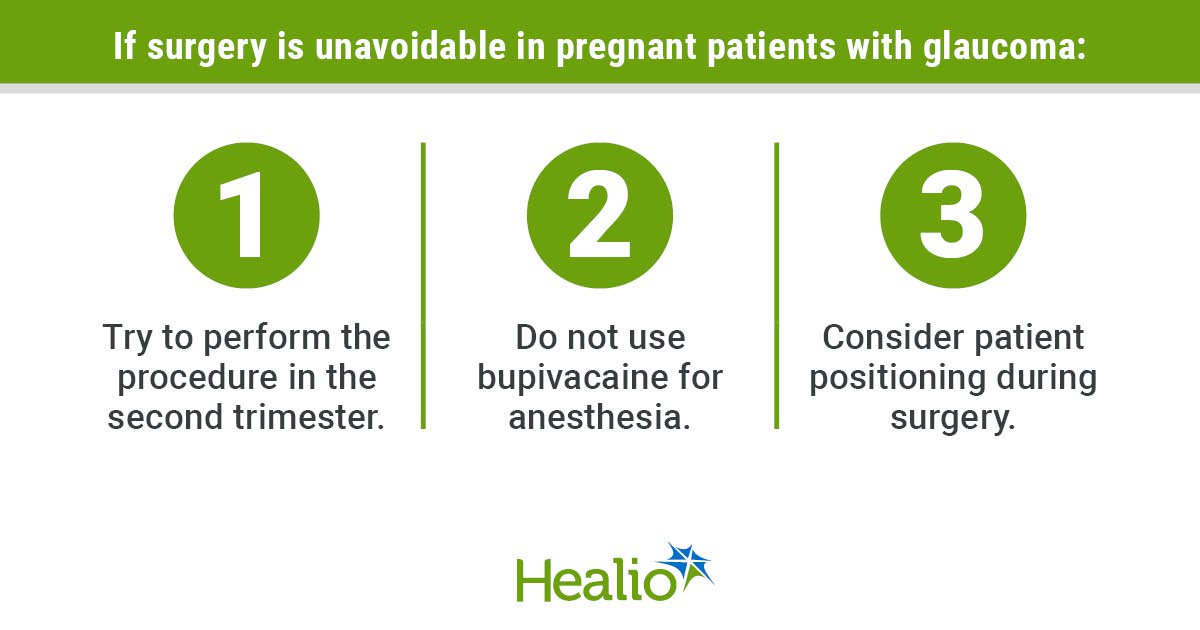
If surgery is unavoidable, Radhakrishnan recommended that ophthalmologists aim to perform the procedure during the second trimester due to lower risks for spontaneous abortion and pre-term labor compared with the first trimester and the third trimester, respectively.
“If medically necessary, then intervene regardless of the trimester,” she said.
While no single procedure is perfect, case reports support trabeculectomy, tube shunt procedures and cyclophotocoagulation as options. Radhakrishnan said she could not find any case reports to support angle-based minimally invasive glaucoma surgery, but it can be considered as a reasonable option because it has shorter surgical and recovery times as well as a positive safety profile compared with trabeculectomy and tube shunt procedures. Ophthalmologists should avoid using antimetabolites, which are contraindicated for patients who are pregnant.
“In terms of anesthesia, we can do a great job typically with a combination of topical, subconjunctival and sub-Tenon approaches,” Radhakrishnan said.
Lidocaine, a category B anesthesia, is commonly used for eye surgery in patients who are pregnant, but bupivacaine should be avoided because it is associated with fetal bradycardia.
While operating, Radhakrishnan recommended using a wedge pillow to create a 30° lateral tilt and making sure the patient’s abdomen is turned to the left to reduce risk for aortocaval compression.
After surgery, ophthalmologists are typically able to use topical steroids such as prednisolone and dexamethasone despite being marked as category C for patients who are pregnant.
“The use of topical meds seems to have very little downside,” Radhakrishnan said.
While patients with glaucoma generally receive standard obstetric care during labor, if delivery is anticipated in the immediate period after trabeculectomy or tube shunt procedures, a cesarean section may need to be considered, according to Radhakrishnan.
“These patients require a team approach involving the OB or the maternal fetal medicine specialist, the anesthesiologist and the neonatologist,” she said.
Sources/Disclosures
Source:
Radhakrishnan S. Glaucoma in pregnancy: Is surgery the safest way? Presented at: American Glaucoma Society meeting; Feb. 19-22, 2026; Rancho Mirage, California (hybrid).
Disclosures:
Radhakrishnan reports no relevant financial disclosures.

Ask a clinical question and tap into Healio AI’s knowledge base.
- PubMed, enrolling/recruiting trials, guidelines
- Clinical Guidance, Healio CME, FDA news
- Healio’s exclusive daily news coverage of clinical data
<












Leave a Reply