
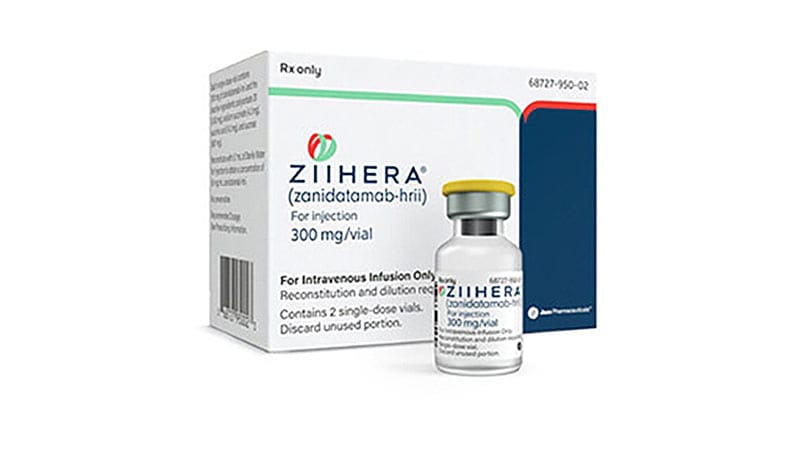
Patients with a rare form of bile duct cancer could soon benefit from a new treatment option after the National Institute for Health and Care Excellence (NICE) recommended zanidatamab for NHS use in final draft guidance.
The targeted “life-extending” treatment zanidatamab (Ziihera, Jazz Pharmaceuticals) is recommended for HER2-positive — defined as immunohistochemistry 3 (IHC3) positive — unresectable locally advanced or metastatic biliary tract cancer in adults after at least one line of systemic treatment.
Biliary tract cancer — encompassing cholangiocarcinoma (bile duct cancer), gallbladder cancer, and ampullary cancer — is often diagnosed late, by which point surgery is no longer an option. Fewer than 1 in 3 people in England survive for a year after diagnosis, and until now, treatment options for patients whose cancer had progressed have been limited.
NICE said the treatment would provide patients “more time with better quality of life.” Around 65 people a year in England are expected to be eligible for it.
Increased Overall Survival
Usual treatment for HER2-positive (IHC3 positive) unresectable advanced biliary tract cancer after at least one line of systemic treatment varied, NICE said. If further treatment was suitable, people usually had FOLFOX chemotherapy with active symptom control. If this was not suitable, people usually had active symptom control alone.
Zanidatamab is a HER2-targeted bispecific antibody that treats HER2-expressing cancers by simultaneously binding to two different areas of the HER2 protein. This blocks growth signals, triggers HER2 internalisation, and activates the immune system to destroy tumour cells.
In its final draft guidance, NICE referenced the clinical evidence for zanidatamab from the HERIZON-BTC-01 trial — a phase 2b, open-label, multicentre, international, single-arm trial that included people with HER2-amplified unresectable locally advanced or metastatic biliary tract cancer after one or more lines of treatment. In the IHC3-positive cohort who received zanidatamab, the median progression-free survival was 7.2 months and the median overall survival was 18.1 months. NICE noted that overall survival for those receiving standard chemotherapy was around 6 months.
Although zanidatamab had not been directly compared in a clinical trial with FOLFOX or active symptom control, indirect comparisons suggested it was likely to increase how long people lived compared with usual treatment, NICE said.
Greater Convenience
Zanidatamab is administered by intravenous infusion once every 2 weeks, which is less frequently than FOLFOX. An implanted central venous access device is also not required for its administration.
Both of these aspects might release capacity at hospitals providing care, NICE said.
Rob Hicks is a retired National Health Service doctor. A well-known TV and radio broadcaster, he has written several books and has regularly contributed to national newspapers, magazines, and online publications. He is based in the United Kingdom.
<














Leave a Reply