
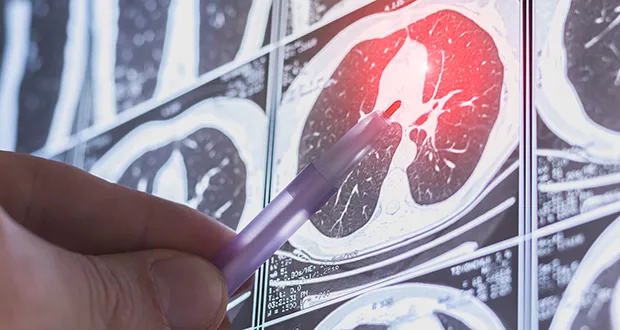
It is hoped that a pilot lung cancer screening project will lead to a national service aimed at detecting the disease sooner and saving lives, writes Michael McHale
Despite advances in treatments and greater awareness, lung cancer continues to be one of the deadliest diseases in Ireland. Around 2,700 are diagnosed with a lung tumour here each year. Just one-in-four (24 per cent) will live for five years or more post-diagnosis.
But finding the cancer early can make a huge difference. When diagnosed at stage 1, five-year survival rates for the disease rise to 68 per cent.
It’s no wonder, then, that leading oncologists in this field are so eager to see the pilot of a new lung cancer screening project be successful and lead to the development of a national screening service.
In May the Beaumont-RCSI-Irish Cancer Society Lung Health Check screened its first person for lung cancer. Focusing on the North Dublin and North-East region, the project involves a mobile scanning unit that moves around local GAA clubs in the area to reach people as close to their communities as possible.
Screening is undertaken with a CT scanner, and eligibility for the service is determined through GP data and one-to-one phone calls
Screening is undertaken with a CT scanner, and eligibility for the service is determined through GP data and one-to-one phone calls with people to determine their risk level for the disease.
The project has been a number of years in the making, led by Prof. Jarushka Naidoo, consultant medical oncologist at Beaumont Hospital and professor in the Department of Medicine at the Royal College of Surgeons (RCSI).
With funding from the Irish Cancer Society and support by the EU4Health SOLACE consortium, the clinical trial aims to provide two rounds of screening – each one year apart – to 2,000 people.
Its results will then be collated and presented to health officials to demonstrate the potential impact a national lung cancer screening programme could have on detecting the disease earlier, and saving lives.
According to Prof. Daniel Ryan, a consultant respiratory physician in Beaumont who is also working closely on the project, around 13 per cent of all lung cancers in the country are diagnosed in North Dublin and North East.
“Demographics and census data would suggest that there’s a high prevalence of lung cancer, high socioeconomic deprivation and high smoking levels in those areas. It also has one of the fastest growing elderly populations in the country,” he said.
“Lung cancer screening in itself has been proven to reduce mortality by at least 20 per cent in large trials going back 10 or 15 years in the United States and Europe.”
The first of these studies – the US-based National Lung Cancer Screening Trial – involved almost 55,000 high-risk patients. It found significant improvements in survival rates among patients who were screening using CT scanning compared to those who had a chest X-ray.
The European NELSON trial, which involved 15,000 people over four rounds of screening, showed that scanning led to a reduction in mortality of 24 per cent after ten years.
“But one of the issues has been that uptake has been low in places like the United States, because they can be a hard group to get in contact with,” added Prof. Ryan.
“What they’ve done in England is focus on how to reach out to these populations and how to get them involved in lung cancer screening, because the more people you get involved, the more cancers you identify, and the more economically viable screening becomes.”
The use of a mobile unit for the Irish project has been modelled on this approach, which brings a screening truck to areas of higher economic disadvantage.
The Beaumont-RCSI Cancer Centre project has also adopted the English approach of using the lung screening units as a ‘one-stop-shop’ for the public to find out more about their overall lung health.
Services integrated into the project include spirometry, Stop Smoking advice, and signposting supports provided by the Irish Cancer Society.
With screening uptake rates in the England programmes at around 50 per cent, plans are now in place to launch a national service there by 2029, with capacity to screen one million people annually.
Prof. Ryan and his colleagues will be hoping that their pilot project will lead to Ireland following suit.
In order to reach people, the research team has partnered with Centric Health, a primary care group with 19 GP-led clinics in the North Dublin and North-East region.
“We wanted to work with a group of GP practices, and we’ve been working with them hand-in-hand for two to three years to set up systems by which we could effectively contact their patients,” said Prof. Ryan.
Through the Health Research Consent Declaration Committee (HRCDC), the project was given special dispensation to receive a dataset of names, addresses and phone numbers of patients aged between 55 and 74.
A letter from their GP practice is then issued to those in the dataset, which includes information on what the lung health check would entail, as well as a time and date for when the screening team intends to phone them as part of the initial stage of the process.
The resulting phone call involves a series of questions used to determine whether that person is eligible for lung screening. Issues addressed in this call include the person’s smoking history and medical background, in particular looking at any previous cancer diagnoses.
“We use special scoring systems then to see if they are at a relatively increased risk for lung cancer over the next five to six years. If they hit those metrics, we invite them to the truck for a lung health check.”
Around 10,000 people have already been contacted about the service, resulting in more than 1,500 screenings being carried out.
“When they come they have a lung health check and a low dose CT scan,” Prof. Ryan explained.
“The vast majority of those will be clear and they’ll just go straight forward to having a repeat CT scan one year later. A smaller number – about 13 per cent of people – will have a small nodule or spot in the lung that we need to keep a closer eye on.”
This group is asked to return for another scan three months later. If that scan is clear, they will be invited for another regular screening in 12 months’ time.
“If we have a case where we feel a patient has lung cancer, or they need further investigations, the patient is contacted by letter and over the phone, and then we invite them to the Rapid Access Lung Clinic, either here in Beaumont or in (Our Lady of Lourdes Hospital) Drogheda, depending on where they’re located.”
It is clear that a national rollout of lung screening would have a significant impact on resources
It is clear that a national rollout of lung screening would have a significant impact on resources – be that the additional CT scanners required to screen all eligible people, or the extra respiratory physicians, radiologists and thoracic surgeons required to treat the additional lung cancers detected.
“You would be finding a lot more lung cancers, but you’d be finding them significantly earlier where they can all be operated on and cured effectively, rather than patients turning up with a more advanced stage cancer later down the line, which has huge economic ramifications for the healthcare system,” Prof. Ryan said.
“We know from the data in the UK that there’s an economic rationale for lung cancer screening – the quality-of-life years, the cost per quality-of-life being saved has made it very cost effective. I don’t see why Ireland would be any different in that regard.”
The study is part of a six-year Beaumont-RCSI-Irish Cancer Society Lung Outreach Programme, which aims to advance cutting-edge cancer care, focusing on early detection, advanced diagnostics, and innovative treatments.
The programme will also include the study of a liquid biopsy. This rapid blood test will be assessed to determine its impact in identifying whether patients with newly diagnosed lung cancer may benefit from more tailored, personalised treatments.
Additional research will test immunotherapies for KRAS-mutant lung cancers, caused by a common gene mutation that leads to the KRAS protein allowing for excessive cell growth.
The six-year project will be led by Prof. Naidoo. “This programme represents a paradigm shift for lung cancer care and innovation in Ireland,” she said.
“By combining the expertise of clinicians and scientists at the Beaumont RCSI Cancer Centre with vital support from the Irish Cancer Society, we will not only detect lung cancer earlier but also deliver more personalised and effective treatments. This funding is a critical turning point – the largest investment for lung cancer – where it is much needed, and for those at greatest risk.” 
<








Leave a Reply