
January 30, 2026
2 min read

Key takeaways:
- Under-detection of human rabies is a global problem, according to researchers.
- Antemortem testing using four sample types had a 100% diagnostic sensitivity.
Researchers found that antemortem testing could increase detection and lead to more timely public health interventions for human rabies, which is under-diagnosed globally.
“Human rabies under-detection is a global challenge due in part to under-testing,” Shama Cash-Goldwasser, MD, a medical officer with the CDC’s Poxvirus and Rabies Branch, told Healio.

Data derived from Swedberg C, et al. Clin Infect Dis. 2025;doi:10.1093/cid/ciaf666.
According to Cash-Goldwasser, there are 74,000 human rabies deaths each year, but very few are diagnosed before the person dies. She noted that the United States averages fewer than 10 rabies deaths per year “due to a robust public health prevention system that oversees the post-exposure vaccination of nearly 100,000 Americans to prevent infection after possible exposure to the virus each year.”
“However, we estimate that as many of 50% of human rabies deaths in the United States go undetected due to challenges developing clinical suspicion for rabies and conducting diagnostic testing as recommended,” she said.
One such example was a recently missed case of human rabies transmitted through the donation of a rabies-infected organ. According to reports, a Michigan resident received a kidney from a deceased donor who had been bitten by a skunk, did not seek medical treatment, and died 5 weeks later. Following the death of the kidney recipient, three other patients who received transplants from the same donor began post-exposure prophylaxis and a fourth patient’s transplant was intercepted.
“There are diagnostic tests that can detect human rabies before a patient dies, and we know that antemortem diagnosis of human rabies improves patient management and facilitates early public health responses to prevent additional cases,” Cash-Goldwasser said.
To characterize the diagnostic sensitivity of antemortem sample types and assess the timing of collection, Cash-Goldwasser and colleagues studied CDC data on 69 confirmed human rabies cases reported between 1990 and 2024 and 382 antemortem samples collected from their saliva, nuchal skin, serum and cerebrospinal fluid.
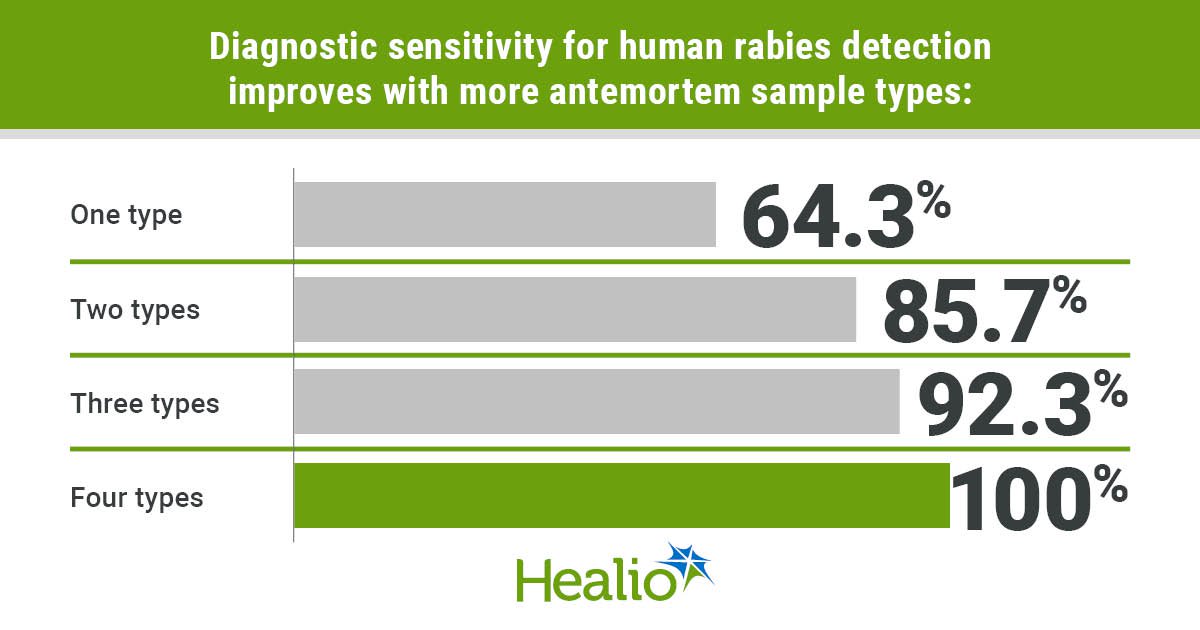
In cases with four antemortem samples, testing had a combined diagnostic sensitivity of 100% with a 2% or less risk for a false negative result. Cases with fewer sample types had lower diagnostic sensitivity — 92.3% with three sample types, 85.7% with two sample types and 64.3% with one antemortem sample type.
The researchers also found that patients were often hospitalized within 2 to 6 days of symptom onset, with survival time being an average of 16 days after symptom onset.
“This shows how quickly symptoms progress in many rabies cases and that there is a relatively short window to make the diagnosis and provide potential experimental treatments,” Cash-Goldwasser said.
She added, however, that nearly a quarter of patients survived longer than 21 days which also shows that survival beyond 3 weeks is “not unusual and does not rule out a diagnosis of rabies.”
Rabies is among the world’s deadliest diseases, almost always fatal once symptoms appear. The study showed that 80% of cases involved animal exposure. Following a decades-long decline in canine rabies driven by high vaccination rates, bats are the most common cause of human infections in the U.S.
“Early diagnosis of human rabies, while a patient is alive, is critical to facilitate appropriate clinical management and timely public health action so that additional rabies deaths — such as the recently reported transplant-associated case — are prevented,” Cash-Goldwasser said. “It is critical to use testing strategies that maximize the chance of antemortem detection, especially if the precise date of symptom onset is not known or if testing of all recommended sample types is not possible.”
For more information:
Shama Cash-Goldwasser, MD, can be reached at media@cdc.gov.

Ask a clinical question and tap into Healio AI’s knowledge base.
- PubMed, enrolling/recruiting trials, guidelines
- Clinical Guidance, Healio CME, FDA news
- Healio’s exclusive daily news coverage of clinical data
<










Leave a Reply