
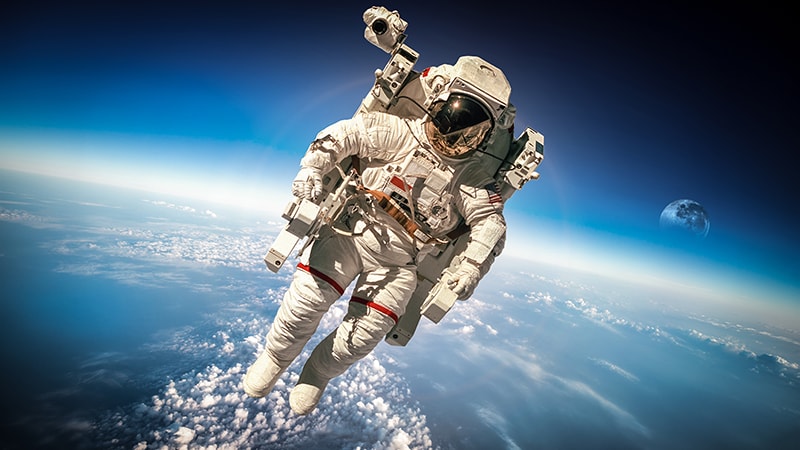
When a body accustomed to Earth’s gravity enters the microgravity environment of space, almost all physiologic systems are reorganized.
Speaking with El Médico Interactivo, part of the Medscape Professional Network, Rodrigo Aispuru, MD, PhD, family physician and coordinator of the Musculoskeletal Working Group of the Spanish Society of Primary Care Physicians in Spain, said.
“The skeleton and the muscles of the legs and spine, which are designed to support body weight, stop working and begin to lose bone mass and muscle strength at a rate far greater than normal aging, resembling an accelerated form of osteoporosis and sarcopenia.”
The cardiovascular (CV) system is also affected by microgravity. Body fluids shift toward the upper part of the body, plasma volume decreases, and the heart, which encounters less resistance, may gradually become deconditioned during long-term spaceflight. “That is why, on return to Earth, orthostatic intolerance is common, with dizziness and a feeling of faintness,” said Aispuru.
The nervous system, particularly the vestibular system, becomes disoriented because a constant reference of gravity is no longer available. According to the specialist, this results in motion sickness, vertigo, and difficulty walking steadily during the first few days after the landing. “Visual changes have also been described in some astronauts, possibly related to increased intracranial pressure, as well as alterations in the immune system, metabolism, and sleep. In addition, high exposure to ionizing radiation can damage DNA. Altogether, this creates a complex clinical picture, with manifestations that are often transient but require very careful follow-up.”
Training and Prevention
The life of an astronaut is largely determined by training and preventive measures. “From the selection process onward, candidates are chosen for excellent health, without major CV risk factors, and with strong physical and psychological capacity to withstand hostile and confined environments,” Aispuru noted.
Before launch, astronauts undergo highly demanding exercise programs. Once in orbit, daily training becomes mandatory, with approximately 2 h/d devoted to aerobic and strength exercises using equipment adapted to microgravity to slow the loss of muscle mass, bone density, and CV capacity.
“In addition to exercise, attention is paid to nutrition, including calcium and vitamin D intake, sleep hygiene, psychological support, and, in some cases, the use of specific medications to protect bone or manage particular symptoms,” Aispuru said.
“On return to Earth, astronauts do not simply go home. They undergo intensive rehabilitation programs and prolonged medical follow-up within the framework of lifelong health registries designed to detect any late complications as early as possible.”
Men and Women
Comparisons between men and women in space are limited by the relatively small number of astronauts, particularly women; however, some differences have been observed between the sexes. Available studies suggest that women experience orthostatic intolerance, including dizziness and syncope, more frequently after returning to Earth. This is thought to be related to the greater plasma volume loss and baseline physiologic differences between the two.
In contrast, according to Aispuru, certain visual disturbances linked to possible changes in intracranial pressure have been reported more often in men, although the number of cases is small and the underlying mechanisms remain unclear.
With respect to bone health, both sexes lose bone density in microgravity. However, women have a higher baseline risk for osteoporosis and fractures with age. If part of the bone loss is not fully recovered, it could place them at a higher long-term risk. Overall, “experts do not suggest that space is much worse for one sex than the other, but rather that there are partially distinct risk profiles that require tailored countermeasures and continued research.”
Fertility
Reproductive health remains a particularly sensitive issue, and evidence regarding this in humans is limited. “There are no data indicating that short- or medium-duration flights cause sterility in men or women,” said Aispuru. “However, there is concern about two factors: ionizing radiation, which can damage the DNA of sperm and oocytes, and the hormonal and metabolic changes associated with prolonged missions.”
For precautionary reasons, space agencies tend to plan pregnancies well before or after missions and monitor reproductive function, although large, long-term human series are still lacking.
Much of the available evidence comes from animal studies, Aispuru added. These studies have shown alterations in spermatogenesis, the ovarian cycle, and embryonic development under simulated microgravity and radiation exposure conditions. “These findings suggest a potential risk for fertility and offspring health in scenarios of prolonged exposure, such as future missions to Mars, but they cannot yet be extrapolated reliably to human clinical practice.”
Long-Term Effects
Most acute changes observed during or immediately after spaceflight are at least partially reversible; however, this does not mean that the long-term risk is negligible.
From a musculoskeletal perspective, many astronauts recover much of their bone and muscle mass through rehabilitation. However, some studies suggest that a residual deficit may persist and, when combined with aging, increase the likelihood of osteoporosis and fractures years later.
In terms of CV health, short-duration missions have not been clearly associated with higher rates of myocardial infarction or stroke than those in the general population. Nonetheless, the combination of hemodynamic changes, possible alterations in arterial stiffness, and radiation exposure justifies the need for close surveillance.
Long-Term Complications
One of the major long-term concerns is the possible risk for cancer and CV disease attributable to space radiation and somatic mutations detected in some astronauts. This has prompted the development of specific risk estimation models and lifelong follow-up programs that include tailored oncologic and CV screening. The potential neurocognitive and psychological effects of isolation and radiation on memory, executive function, and mental health are also being studied, although the current data are limited and based on small cohorts.
Overall, being an astronaut involves assuming additional health risks, particularly to the bones, muscles, and CV system, and cancer risks. However, astronauts represent a highly selected and closely monitored population, and increasingly sophisticated countermeasures substantially reduce these risks.
Aispuru reported having no relevant conflicts of interest.
This story was translated from El Medico Interactivo.
<









Leave a Reply