
April 19, 2026
6 min read
Key takeaways:
- The study included 72,025 TBIs related to sports.
- Studies of studies of older teens with TBI have been applied to younger children in the past.
- Families should be educated about risks when children are young.
CHICAGO — Football players experienced nearly one out of every five traumatic brain injuries among youth athletes, according to a poster presented at the American Academy of Neurology’s 78th Annual Meeting.
These injuries frequently recurred, and the neurological and psychiatric sequelae were substantial, according to Isaac Thorman, MSc, a rising fourth year medical student at New York Medical College, and colleagues.

Data derived from Thorman I, et al. Youth football and the epidemic of pediatric brain injury: Neurologic and psychiatric outcomes in a multinational cohort of 72,025 concussions. Presented at: American Academy of Neurology Annual Meeting; April 18-22, 2026; Chicago.
“The mechanisms by which kids and adults get their TBIs are very interesting and tell us a lot about what goes on in their lives and how that can influence the outcomes,” Thorman told Healio.
Previous research has examined TBIs among elite athletes at the collegiate, professional and international levels, but there is little data about children and adolescents at the population scale, he said.

Isaac Thorman
“There hasn’t been the type of big unifying study that we would love to see that unites ages, that unites different activities, and follows these children out for a couple of years at least to look at how their lives are affected by these injuries,” Thorman said.
On the field
Thorman and colleagues conducted a retrospective cohort study that comprised 72,025 activity-related TBIs (mean age, 13.9 years; 32% female) among children and adults aged 25 years and younger in the TriNetX Research Network.
“We found this repository of great data relating to how children get TBI,” Thorman said.
Using ICD-10 diagnosis codes, the researchers identified patients with a first TBI related to sports or recreation. As a control, they matched these cases with patients who had fractured a lower leg during the same activity with no TBI.
“As we started to quantify that data and separate it out by age, it became apparent that there are distinct trends in the data that show us that certain sports may be at higher risks and that the TBIs associated with those sports have very distinct profiles of consequences,” Thorman said.
The most common sport or activity was football, accounting for 19.4% of all TBI, followed by soccer at 11%, basketball at 10% and cycling at 7%. Other sports and activities included baseball, cheerleading, field hockey, hiking, ice hockey, lacrosse, roller skating, running, skiing, snowboarding, volleyball and wrestling.
Study author Steven M. Wolf, MD, professor of clinical neurology and pediatrics at New York Medical College, noted the unexpected risks that come with cheerleading.
“I’m very scared of the flyers. I’ve seen way too many injuries. I’ve even seen people at the bottom of the pyramid be at risk,” he told Healio. “As a pediatric neurologist, I would never have thought of counseling a young cheerleader in middle school about the risk of concussion.”
Overall, 32% of patients with TBI had repeat TBI. Specifically, 37% of football players with TBI had repeat TBI.
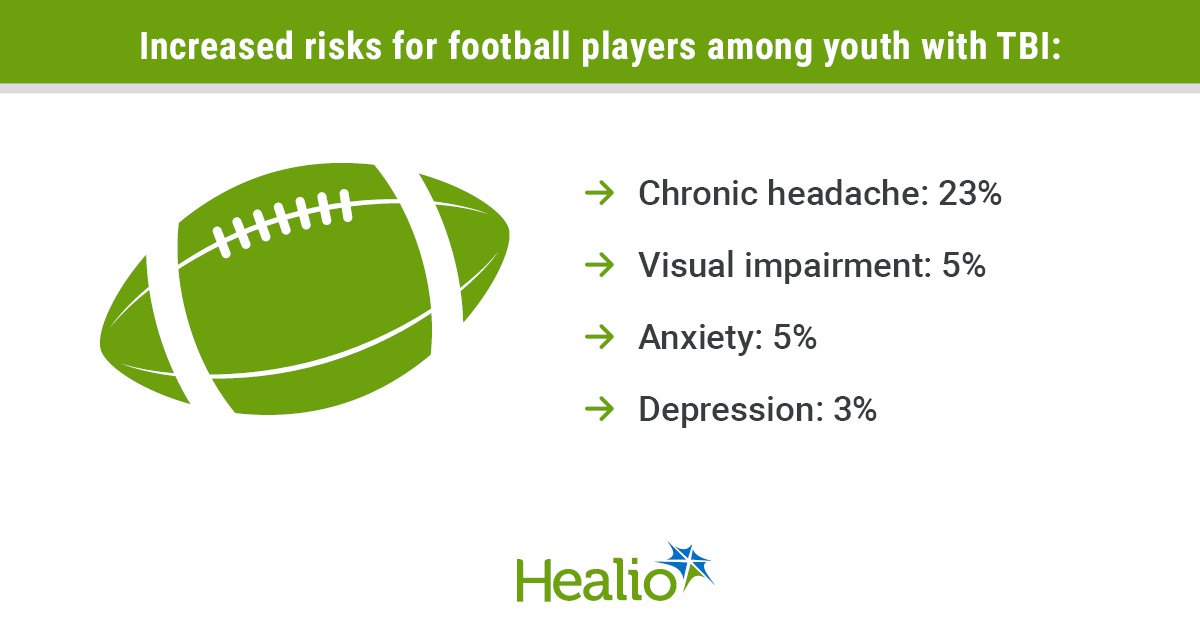
Football players were 22.9% more likely to develop headache and migraine and 4% more likely to develop visual impairment such as double vision, decreased ability to see or complete blindness, which the researchers called rare.

Steven M. Wolf
Also, football players were 0.5% more likely to develop neurodevelopmental disorders, 5% more likely to develop anxiety, 3% more likely to develop depression, 1% more likely to develop substance use and 0.5% more likely to develop suicidality or violence.
“It’s the emotional dysregulation, the depression, anxiety, the substance use, things that come up possibly years later, that really I found more surprising, because the headaches are well known,” Thorman said.
“Headaches are the number one symptom of post-concussion syndrome,” he continued. “But the emotional regulation may be a bit more subtle and something that’s not necessarily picked up on without these kinds of large population studies.”
The researchers called all these risks significantly elevated.
Headaches and migraines were experienced by 20.7% of these patients overall, most commonly in cheerleading (29.5%), volleyball (27%) and soccer (24.2%).
Post-concussion syndrome was experienced by 5.2% overall, led by cheerleading (8.2%), volleyball (7.2%) and wrestling (6.1%).
Mood disorders impacted 2.7% overall, led by cheerleading at 4.4%. Anxiety disorders affected 4.2% overall, led by baseball at 6.1%. Neurodevelopmental disorders impacted 0.1% overall, led by bicycle riding at 0.9%.
Vision/blindness affected 4% overall, led by volleyball at 5.6%. Substance use disorders affected 1.1% overall, led by roller skating and skateboarding at 4.5%.
Additionally, developmental and mood disorders were more likely to develop among patients who experienced TBI when they were younger, and substance use disorders were more likely among those who experienced TBI when they were older.
Educating clinicians, families
Wolf emphasized that people generally know about the risks for professional athletes and for adults who participate in sports, but they are not aware of the risks for children and adolescents.
“Families will show up in our office after a concussion and say, ‘Well, really, I didn’t know the sport had such a risk or such a consequence,’” he said.
Now, he continued, this data enables clinicians to have informed conversations about these risks with these families.
“These were really things that made me realize that I need to do better counseling as a clinician based on this data,” Wolf said. “That’s the takeaway for me as a clinician.”
Particularly, Thorman said, families and clinicians alike need to acknowledge the differences between adult injuries and pediatric injuries.
“Children are not mini adults,” he said.
Young adults and older teenagers are in much later stages of development, and most of their growth has already happened, Thorman said. Yet conclusions based on studies of these patients have been applied to younger children.
“There’s an extrapolation going from older people to younger people that may not really be a fair comparison,” he said.
Wolf also noted the misperception that children are resilient and can shake off these injuries.
“They are even more unlikely to express their symptoms because they want to appear tough,” he added.
Additionally, caregivers and coaches may encourage children to “tough it up” when they get hurt and get back in the game, which is a common attitude in sports for older athletes.
“It’s very difficult to develop a culture in sports where children are feeling empowered to come forward and say, ‘I was hit in the head,’” Thorman said.
Months later, these children may say that they have been experiencing headaches because of that hit.
“When more awareness is brought to these issues, it may help open some minds to taking those concerns more seriously and encouraging kids to say, ‘Hold on. I may not be feeling great right now. I need to sit down,’” Thorman said.
Wolf also said that families should be educated about the risks of these sports when their children are still young, adding that even sports like wrestling and volleyball come with risks.
“But at the same time, we want children to be children,” he said.
When children participate in sports, he said, they need to be trained properly. Coaches need to have good safety awareness too. For example, he said, young football players need to understand proper tackling form.
“The same thing in soccer, when jumping up for a header,” he added. “It’s about the skill set and training.”
Wolf also emphasized that children should wear helmets while riding bicycles or skateboards, roller skating or roller blading, participating in snow sports like skiing or snowboarding, and while playing lacrosse.
Children even need to exercise caution while on the golf course, Thorman said.
“The sport that had some of the most severe injuries was golf, because almost 100% of kids who get hit in the head with a golf club end up with depressed skull fractures in the ICU,” he said. “There’s no one way to be safe.”
“We want everybody to keep their brains in the right space and not have concussions,” Wolf said.
Next, Thorman and Wolf said they will use the data to create advice and guidelines for primary care doctors and pediatric neurologists to help them discuss these risks with families and create better awareness.
Both want to see a safe, child-friendly world that is not overly protective.
“I would say 25% of calls to our office to set up an appointment for concussion are not concussions,” Wolf said. “We need to do some good education on what needs to be evaluated.”
Wolf envisioned a protocol that families can use when injuries happen.
“What do they do, so we don’t overuse medical resources, and we don’t underuse medical resources?” he said. “I don’t want to ignore the important ones, but I don’t want someone going to the ER for every little bump or every little headache.”
For more information:
Isaac Thorman, MSc, can be reached at ithorman@student.nymc.edu. Steven M. Wolf, MD, can be reached at Steven_Wolf@bchphysicians.org.
Sources/Disclosures
Source:
Thorman I, et al. Youth football and the epidemic of pediatric brain injury: Neurologic and psychiatric outcomes in a multinational cohort of 72,025 concussions. Presented at: American Academy of Neurology Annual Meeting; April 18-22, 2026; Chicago.
Reference:
Study: Football associated with nearly one in five brain injuries in youth sports. https://www.aan.com/PressRoom/Home/PressRelease/5324. Published: March 2, 2026. Accessed April 13, 2026.
Disclosures:
Thorman and Wolf report no relevant financial disclosures.

Ask a clinical question and tap into Healio AI’s knowledge base.
- PubMed, enrolling/recruiting trials, guidelines
- Clinical Guidance, Healio CME, FDA news
- Healio’s exclusive daily news coverage of clinical data
<











Leave a Reply