
A reset of the government’s hospital building programme in England has put long-term plans on a more stable footing, the spending watchdog has said. However, hospitals built with unsafe concrete will now miss the 2030 replacement deadline set last year.
The National Audit Office (NAO) said replacements for seven hospitals constructed largely using reinforced autoclaved aerated concrete (RAAC) are now not expected to open until 2032-2033, despite being prioritised for early delivery.
The Department of Health and Social Care (DHSC) reset the New Hospital Programme in January 2025 after reviewing costs and timetables. The programme now covers 41 schemes, to be delivered in four waves over the next 20 years, ranging from full rebuilds to major refurbishments. Five schemes had already been completed.
Huge Maintenance Costs From Faulty Concrete
The NAO said the seven RAAC hospitals remain in use but require extensive mitigation and ongoing maintenance to manage safety risks until replacement buildings are completed.
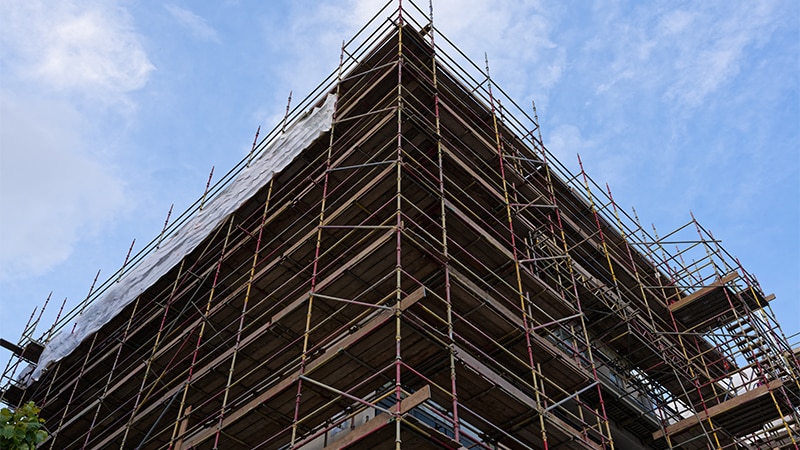
Some sites have closed unsafe areas, while others are using temporary measures such as steel propping and scaffolding to support weakened structures. Trusts are facing rising costs to keep buildings operational and safe.
The seven hospitals had required more than £500 million of investment by 2025 to prevent structural failure. The DHSC estimated that delays to new hospitals or major refurbishments would add between £100 million and £140 million a year in additional maintenance costs.
RAAC was widely used from the 1950s to the mid-1990s as a lightweight and relatively low-cost alternative to traditional concrete, particularly in public buildings such as schools and hospitals.
Concerns escalated in 2023 when the material’s tendency to fail without warning became clear. Its internal structure has been likened to the bubbly texture of an Aero chocolate bar. Scores of schools were forced to close while safety checks were carried out. RAAC is now recognised as having inherent structural weaknesses, exacerbated by ageing and poor maintenance.
Completion Pushed Into the 2040s
The NAO said that the revised timetable for the New Hospital Programme was more realistic but warned that full completion is not expected before 2045-2046.
It said significant delivery risks remain because of a tight construction schedule, limited contingency planning over the next 5 years, and workforce shortages across the construction sector.
The government has allocated £2 billion a year to the programme from 2025-2026 to 2029-2030, rising to £3 billion a year from 2030-2031. Total capital funding is now estimated at about £56 billion, £33.8 billion higher than plans set out in 2023. A £12 billion contingency, equivalent to 21%, has been included to reflect inflation, market pressures, engineering challenges, and environmental requirements.
Single Rooms and ‘Hospital 2.0’
The programme includes a standardised approach to design and construction, known as “hospital 2.0”, aimed at improving efficiency and patient care.
Plans include single patient rooms to improve infection control, privacy, and dignity; shorter walking distances for staff; paperless records; and technologies such as infrared sensors to detect patient falls.
Across 28 hospital 2.0 schemes, the NAO said a new and more transparent demand model has replaced earlier assumptions that risked undersized buildings. The DHSC has reduced its planning assumption for bed occupancy from 95% to 92% to allow greater surge capacity. The model also assumes an average 6% increase in overnight beds, alongside a major shift of care into the community.
Warnings Over Normalising Unsafe Buildings
Sir Geoffrey Clifton-Brown, chair of the Committee of Public Accounts, said new hospitals were “desperately needed” and that the DHSC’s more centralised approach could deliver better value for money.
“However, further delays in fully addressing crumbling RAAC in hospitals pose significant clinical and cost risks, which must be addressed as a matter of urgency,” he said.
NHS Providers said the revised timetable risked “normalising unsafe NHS buildings”, while adding millions of pounds to repair bills. Its chief executive, Daniel Elkeles, said that with some schemes now not expected to begin construction until 2039, outdated facilities would remain in use far longer than planned.
“Ageing hospital buildings may have to stay in use way past their ‘use-by’ dates, putting patients and staff at risk, and costing NHS trusts and taxpayers millions of pounds,” he said.
“But RAAC isn’t the only serious problem across the NHS, and more delays add eye-watering costs and inflation — up to an estimated extra £30 million a year for some schemes — on top of the bill for trying to patch up dilapidated and deteriorating buildings and facilities.”
Government Response
A DHSC spokesperson said: “This report demonstrates this government has put the New Hospital Programme on a stable long-term footing after inheriting a plan that was unfunded and undeliverable.
“We’ve confirmed a sustainable funding plan and an achievable timetable to deliver all schemes in the programme. We are now getting on with building these much-needed facilities as quickly as possible.
“We are backing the NHS with £1.6 billion across the next 4 years to safely remove and mitigate RAAC to protect patient and staff safety and deliver a health service fit for the future.
“The NAO’s interpretation of the changing costs of the scheme is mistaken as this does not include the additional nine hospitals we are now building.”
Dr Sheena Meredith is an established medical writer, editor, and consultant in healthcare communications, with extensive experience writing for medical professionals and the general public. She is qualified in medicine and in law and medical ethics.
This article contains information from PA Media.
<















Leave a Reply