
January 14, 2026
4 min read

Key takeaways:
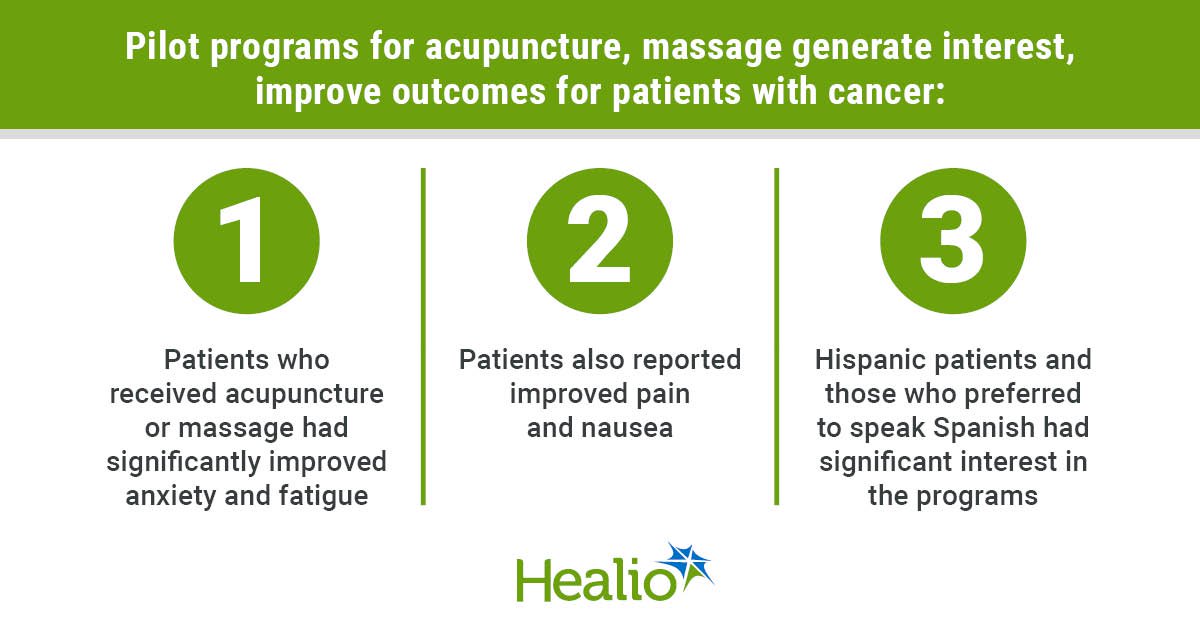
- Patients with cancer who received acupuncture and massage services in a community program reported significantly improved anxiety and fatigue.
- They also reported improved pain and nausea.
A pilot program demonstrated that patients with cancer who frequently do not have access to acupuncture and massage services have substantial interest in them, and the therapies can produce rapid results.
Participants, most of whom came from under-represented backgrounds, reported significant reductions in anxiety and fatigue following acupuncture or massage, and detailed improved pain and nausea, as well.

Data derived from Booher AG, et al. JCO Oncol Pract. 2025;doi:10.1200/OP-25-00321.

Kevin T. Liou
“There definitely is a need for this type of therapy,” Kevin T. Liou, MD, integrative medicine specialist at Memorial Sloan Kettering Cancer Center, told Healio. “In the beginning, there was some skepticism, but we showed that there is significant interest among patients, and [these therapies] could play a big role in managing cancer-related symptoms.
“If you make an effort to make this available on the ground in [the community], you’ll see some barriers, but you’ll see a good amount of people want it once they’re exposed, taught about it and see it in real life.”
Barriers to implementation
Cancer can cause myriad physical and psychological symptoms, all of which can negatively impact quality of life, according to study background.
Prior research has shown that underserved populations based on race, residence and income can experience higher symptom burden and worse outcomes.
ASCO and Society of Integrative Oncology both recently recommended acupuncture and massage for managing pain, and acupressure for fatigue. Previous studies have found acupuncture may improve anxiety and nausea, as well.
Healio recently reported acupuncture significantly improved cognitive function for breast cancer survivors.
Acupuncture and massage services can be found at many comprehensive cancer centers, but multiple barriers have hindered implementation in community settings, including limited reimbursement from Medicare and Medicaid.
“I like to think about barriers in three broad categories,” Liou said. “There are patient-level factors. People may not even be aware this is an evidence-based modality. There are also provider-level barriers. Providers may not know how to connect people to these services, and they may not tell patients about it. And then there are systemic and structural barriers. Cost is one, but also availability. Even if it’s affordable, if it’s not in the neighborhood that people are in, they’re likely not going to access it.”
Liou and colleagues piloted an acupuncture and massage program at MSK Ralph Lauren Center in East Harlem in New York to investigate the impact these therapies could have for underserved individuals with cancer at a community clinic.
They offered services at 635 patient visits (mean age, 55.53 years; standard deviation, 12.63; 77.2% women; 33.9% Black; 44.9% Hispanic; 17.6% white) between April 2022 and August 2024.
Characteristics of patients who agreed to participate, rate of uptake, symptom severity before and after treatment, and satisfaction with the program served as primary endpoints.
Acupuncture, massage improve symptoms
Overall, 59.1% of patients were offered acupuncture and 40.3% were offered massage.
Significantly more patients offered massage received treatment compared with those offered acupuncture (82.4% vs. 48.5%, P < .001).
“It’s interesting. Acupuncture actually has more of a rigorous evidence base behind it for cancer-related symptoms, but there seems to be lower uptake,” Liou said. “Massage seems to have higher uptake, but the strength of the evidence is not as robust as acupuncture in cancer care settings. It’s a little bit of a paradox there.”
Combined, 37.6% of patients declined treatment. The most common reasons for not getting acupuncture or massage included inadequate time (54.4%) and lack of interest (38.9%).
Researchers found treatment receipt occurred significantly more often among women (P < .001), patients who spoke Spanish as their preferred language (P = .016), those of Hispanic ethnicity (P < .001) and those offered massage (P < .001).
“I thought that it was interesting that Hispanic and Spanish-speaking individuals had higher rates of getting their treatment,” Liou said. “Historically, these groups are not what come to mind when you think of acupuncture. It shows that there may be strong cultural alignment with this type of modality.”
Liou and colleagues also observed significant variation based on malignancy, cancer treatment and insurance type (all P < .001). Patients with Medicare and those who received chemotherapy had higher likelihoods of accepting acupuncture or massage.
Participants reported reduced anxiety, fatigue, nausea and pain with acupuncture and massage.
Compared with massage, those who received acupuncture reported significantly worse anxiety (P = .005) and fatigue (P = .001) before treatment, and significantly greater reductions in both anxiety (P = .0079) and fatigue (P < .001) after treatment.
“But both modalities showed improvements immediately post-treatment,” Liou said.
On a 5-point Likert scale, all but one patient who received acupuncture or massage agreed (4) or strongly agreed (5) that the therapy helped them cope and improve their cancer treatment experience.
Researchers acknowledged study limitations, including using visits instead of unique patients. If a patient received therapy at multiple sessions, Liou and colleagues counted them multiple times. Additionally, the services were only offered on specific days, limiting the number of people who could use them.
‘Roadmap’ in place
Liou highlighted several areas of future research, beginning with a closer examination of why nearly 40% of patients did not receive acupuncture or massage treatments when offered.
“What are the barriers?” he asked.
Other integrative medicine modalities also should be investigated in community settings, including music therapy, creative arts therapies, natural products such as herbs and supplements, yoga, and more.
“This was a program evaluation,” Liou said. “It wasn’t a rigorous clinical trial. If we really want to understand the comparative effectiveness of different modalities, we would have to do more of a clinical trial design. That’s another potential next step.”
In 2020, Medicare began covering acupuncture for lower back pain, but there is more work to be done to increase access.
“We have to continue the research, build the evidence base and then work with other stakeholders to advance health policy, get better coverage of integrative medicine,” Liou said. “I think it’s possible. The Medicare policy was the culmination of over 20 years of research and clinical trials showing acupuncture is effective for chronic low back pain. Eventually it got covered. I think that it gives us a roadmap for other insurance plans as well. “Hopefully, it won’t take as long.”
For more information:
Kevin T. Liou, MD, can be reached at liouk@mskcc.org.

Ask a clinical question and tap into Healio AI’s knowledge base.
- PubMed, enrolling/recruiting trials, guidelines
- Clinical Guidance, Healio CME, FDA news
- Healio’s exclusive daily news coverage of clinical data
<






Leave a Reply