
April 17, 2026
5 min read

Key takeaways:
- Many variables make accurate prediction of hemodialysis start and AVF maturation nearly impossible.
- Several studies have pursued “perfect timing” but have not resulted in “on time” development of AVF.
Editor’s note: In a recent study of older patients with end-stage kidney disease living in Europe, researchers found one-third received an arteriovenous fistula within 6 months of starting hemodialysis .
The researchers argued that better prediction of the start of hemodialysis is needed to effectively time vascular access surgery.

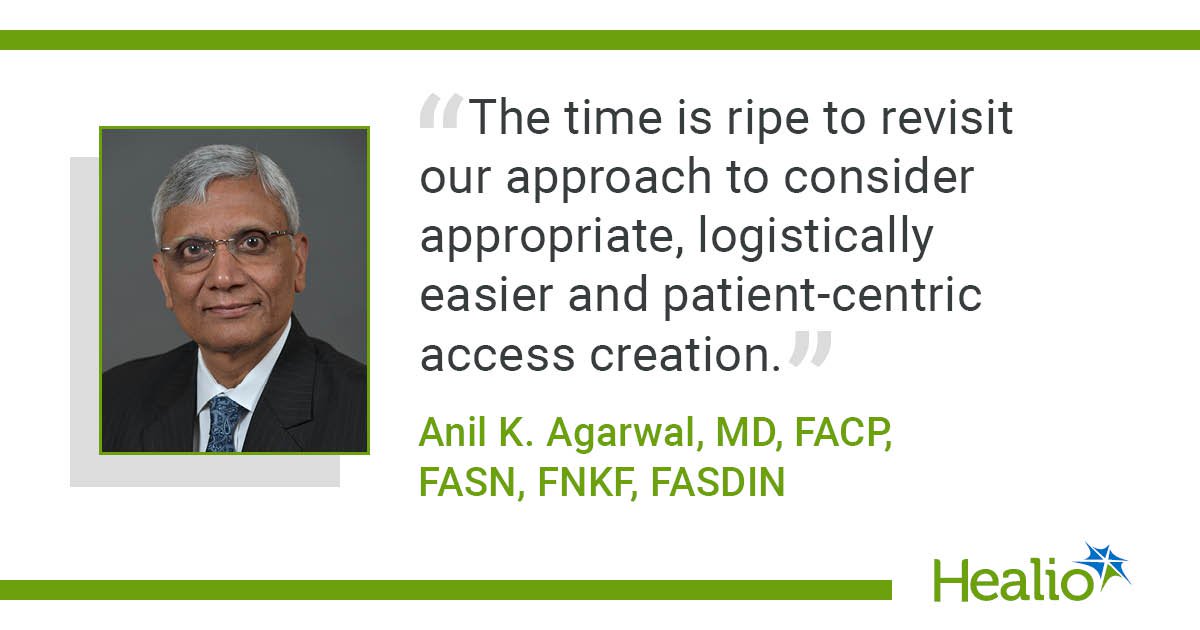
Healio | Nephrology News & Issues asked Editorial Advisory Board Member Anil K. Agarwal, MD, FACP, FASN, FNKF, FASDIN, professor of clinical medicine at the University of California, San Francisco, to weigh in on the question of timing for creating arteriovenous fistulas.
Achieving a mature arteriovenous fistula at the time of hemodialysis initiation has remained the holy grail of hemodialysis vascular access creation — pursued by many but conquered by none.
Despite guidelines recommending creation of an arteriovenous fistula (AVF) approximately 6 months prior to anticipated initiation of hemodialysis, no perfect algorithm or prediction score has evolved to guide such an outcome. This has resulted in an enthusiastic exploration of strategies for success.
The recent study by Boudewijn Heggen, MD, at Maastricht University Medical Center in the Netherlands, and colleagues redemonstrates the challenges in timing of creation of AVF. The study included European elderly patients who had an AVF created and had at least 6 months of follow-up. Those who did not initiate hemodialysis within 6 months of AVF creation were characterized as the early AVF group and on time if they initiated hemodialysis within 6 months of creation. Those initiating hemodialysis with a central venous catheter (CVC) before or within 6 months after AVF creation were considered the late group. Of the 332 patients included, AVF creation was considered on time for 32%, early for 42% and late for 26%. Remarkably, 90% of patients initiated hemodialysis within 3 years.
The authors found no significant difference in the timing of vascular access creation among the six participating countries, depicting the pervasive difficulty in timing AVF creation to avoid CVC insertion for hemodialysis.
The authors quote similar studies of AVF creation from Canada and from U.S. Medicare cohorts older than 70 years. Eighty-one percent of the patients in the Canadian study started hemodialysis within 2 years of AVF creation, and only 67% did so in the U.S. Medicare cohort — with 15% dying before initiating hemodialysis in this cohort. Some of these patients used a different access rather than the initial AVF. Successful maturation rates and access interventions are not described in the manuscript.
Why timing matters
Consequences of inappropriate vascular access creation do exist in both older and younger populations. The risk of never using AVF is relatively less for younger patients due to a longer life expectancy that allows progression to ESKD but poses a higher risk for AVF-related morbidity, and the converse is true in the older population. Morbidity and cost of ineffective access creation also jeopardize societal resources.
The authors recommend the Kidney Failure Risk Equation as a potential strategy to improve estimation of the time when initiation of hemodialysis is needed. Better guidance for timing of creation of vascular access would ensure that AVF are available when needed and would avoid risks from placing a CVC if created too late and risks for unused AVF if created too early.
The equation, however, does not consider the life expectancy of that specific patient, which needs to be clinically correlated. Even a well-timed AVF that matures on time in someone with a short life expectancy would not be meaningfully beneficial to the individual. Thus, it is unlikely that any equation to predict initiation of hemodialysis would result in accurate guidance to create vascular access right on time in the majority of patients.
‘Perfect timing’
Several studies have now pursued “perfect timing” of access creation but have not resulted in “on time” development of AVF.
These studies compel us to reconsider the very philosophy of timely creation of AVF. Questions remain whether we should continue to focus on early or timely AVF creation to satisfy a regulatory mandate or whether the “fistula first” or “catheter last” strategies are universally applicable to patients with a range of comorbidities, age or personal preferences.
Vascular access patterns and outcomes have remained unchanged for more than a decade, and following the same strategies in perpetuity is unlikely to produce different results. The time is ripe to revisit our approach to consider appropriate, logistically easier and patient-centric access creation based on the results of these studies, as well as on many other factors discussed further.
There are many demographic and disease-specific variables that make it nearly impossible to accurately predict when hemodialysis will need to be initiated and when an AVF will mature after creation. The Fistula First initiative in the United States demonstrated that AVF can be created in most patients, will mature in most, but will fail in many despite creation within the guideline-recommended timeframe. Creation of AVF in those with suboptimal vasculature was shown to be fraught with repeated interventions, higher resource utilization and a prolonged catheter use with consequent complications. It is also apparent that early creation of AVF can potentially increase the likelihood of AVF complications, abandonment and sometimes remaining unused due to death or lack of indications for hemodialysis.
The main barrier to “timely” creation of AVF remains the difficulty in predicting when to initiate hemodialysis. This prediction has become even more difficult with emergence of novel therapies to delay progression of chronic kidney disease in addition to renin-angiotensin-aldosterone system blockades. Use of SGLT2 inhibitors, nonsteroidal mineralocorticoid antagonists and GLP-1 receptor agonists can now prolong late-stage CKD without the requirement of dialysis.
If AVF is created based on the guideline recommendations, consequences of early creation of AVF can become even more likely.
Future outlook
Use of arteriovenous grafts (AVGs) can be suitable alternatives to AVF creation in many with challenging vasculature and may also be useful if the need for hemodialysis is relatively urgent and AVF is not available.
Catheters can provide immediate access for those with emergent need of hemodialysis, although catheters are considered undesirable due to their infection risks. It is also important to note that the risk for catheter infection can be reduced with the recent advances in infection prevention measures. In fact, the rates of catheter-related bloodstream infection decreased by 40% between 2014 and 2019. More recently, use of chlorhexidine catheter caps, intracatheter antiseptic devices and catheter locks with taurolidine and heparin (DefenCath, CorMedix) lock solution have demonstrated impressive reductions in the risk for catheter-related bloodstream infection.
Although AVF should certainly be the most preferable access for hemodialysis, utilization of AVG and CVC in appropriate cases can help with more appropriate, albeit late, creation of AVF once the patient is receiving hemodialysis.
It is now imperative for us to create a new paradigm for patient-centric vascular access and move away from the concept of early, timely or late AVF creation. That change in mindset is the only way to alleviate the mandated, mysterious, complex, logistically challenging and costly burden of creating only perfectly timed AVF in everyone.
For more information:
Anil K. Agarwal, MD, FACP, FASN, FNKF, FASDIN, is professor of clinical medicine at the University of California, San Francisco and a Healio | Nephrology News & Issues Editorial Advisory Board Member. He can be reached at anil.agarwal@osumc.edu.
Sources/Disclosures
Source:
Expert Submission
References:
Disclosures:
Agarwal reports being a past president of the American Society of Nephrology and currently a member of North American and Caribbean Regional Board of the International Society of Nephrology. He is an editor of the Journal of Vascular Access and has served as a consultant to Astra Zeneca, Cormedix and Pfizer.

Ask a clinical question and tap into Healio AI’s knowledge base.
- PubMed, enrolling/recruiting trials, guidelines
- Clinical Guidance, Healio CME, FDA news
- Healio’s exclusive daily news coverage of clinical data
<











Leave a Reply