
April 21, 2026
3 min read
Key takeaways:
- Prenatal PFAS exposure was classified as very high, high, intermediate or background.
- A link between very high prenatal PFAS exposure and elevated asthma incidence emerged vs. background exposure.
Children of mothers exposed to very high vs. background concentrations of per- and polyfluoroalkyl substances prenatally had elevated asthma incidence, according to results published in PLoS Medicine.
“It’s important to keep in mind that we only saw an association at very high levels of per- and polyfluoroalkyl substances (PFAS) exposure,” Annelise J. Blomberg, ScD, associate researcher at Lund University, told Healio. “Because of this, our results are not directly applicable to a general population where exposure levels are much, much lower.

“However, our results may be relevant for clinicians who are working in populations that have had high exposures to PFAS, and particularly high exposures via firefighting foam,” Blomberg said.
In a register-based cohort study, Blomberg and colleagues assessed 11,488 children born in Blekinge County, Sweden, between 2006 and 2013 to determine how prenatal PFAS exposure impacts the incidence of asthma and wheeze in childhood.
“In 2013, high levels of PFAS were detected at one of the two municipal water sources in the town of Ronneby, Sweden,” Blomberg told Healio.
Specifically, the researchers wrote, aqueous film-forming foam running off from a military airfield nearby had contaminated the water source. PFAS concentrations included 10,380 ng/L for the contaminated source and 48 ng/L for the non-contaminated source.
“PFAS cross the placenta, transferring from a pregnant mother to her unborn child,” she continued. “This prenatal PFAS exposure may impact the developing immune system. However, previous research on asthma has been inconclusive and has not included a population with high levels of exposure.”
Prenatal PFAS exposure, found by linking maternal address history to water distribution records, was divided into four groups: very high (n = 194), high (n = 479), intermediate (n = 1,591) and background (n = 9,224).
“Prenatal exposure was categorized as ‘very high’ if the child’s mother lived at an address in Ronneby supplied with highly contaminated water for all 5 years preceding the year of delivery; ‘high’ if she lived at an address in Ronneby with contaminated water for at least one of those 5 years; ‘intermediate’ if she lived in Ronneby during that period but never at an address supplied with highly contaminated water; and ‘background’ if she did not live in Ronneby during the 5 years preceding the year of delivery,” Blomberg and colleagues wrote.
Children were followed until age 12 years or Dec. 31, 2022, and at this point, 18% had a wheeze diagnosis, 17% had an asthma diagnosis and 13% had “at least one asthma diagnosis or dispensation of asthma-related prescription drugs after age 36 months (3+ years),” according to the study.
In a Cox proportional hazards model adjusted for several individual-level confounders (maternal smoking in early pregnancy, maternal age at delivery, parity, child sex, parental asthma and socioeconomic factors), researchers found a significant link between very high prenatal PFAS exposure and elevated asthma incidence vs. background exposure (HR = 1.44; 95% CI, 1.08-1.92).
This exposure level was also linked to higher incidence of asthma (3+) vs. background prenatal PFAS exposure (HR = 1.59; 95% CI, 1.14-2.21).
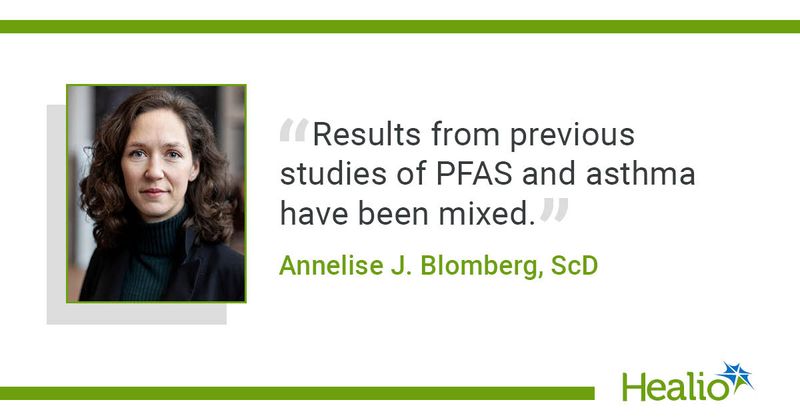
“Our study identified a strong association between very high prenatal PFAS exposure and asthma in childhood,” Blomberg said. “This was surprising to us because results from previous studies of PFAS and asthma have been mixed. Some studies have observed a link between PFAS and asthma, but many have not.
“However, most previous studies only included populations with low levels of PFAS exposure, while our study investigated effects in a population that included children who had been exposed at very high levels from PFAS contamination in their drinking water,” she told Healio.
When evaluating the sets of children with high and intermediate prenatal PFAS exposure, Blomberg and colleagues reported no link to asthma incidence.
For wheeze, the intermediate, high and very high prenatal PFAS exposure groups were not linked to greater wheeze incidence vs. background exposure.
In a secondary analysis that included the children with very high prenatal PFAS exposure and 582 matched background-exposed children, the very high-exposed cohort had a greater estimated cumulative incidence of asthma (26.7% vs. 16.1%) and asthma (3+) (21.5% vs. 11.1%).
“This is one of the first studies to observe a link between high PFAS exposures and asthma, and future studies are needed to verify our results in other populations,” Blomberg told Healio.
For more information:
Annelise J. Blomberg, ScD, can be reached at annelise.blomberg@med.lu.se.

Ask a clinical question and tap into Healio AI’s knowledge base.
- PubMed, enrolling/recruiting trials, guidelines
- Clinical Guidance, Healio CME, FDA news
- Healio’s exclusive daily news coverage of clinical data
<








Leave a Reply